

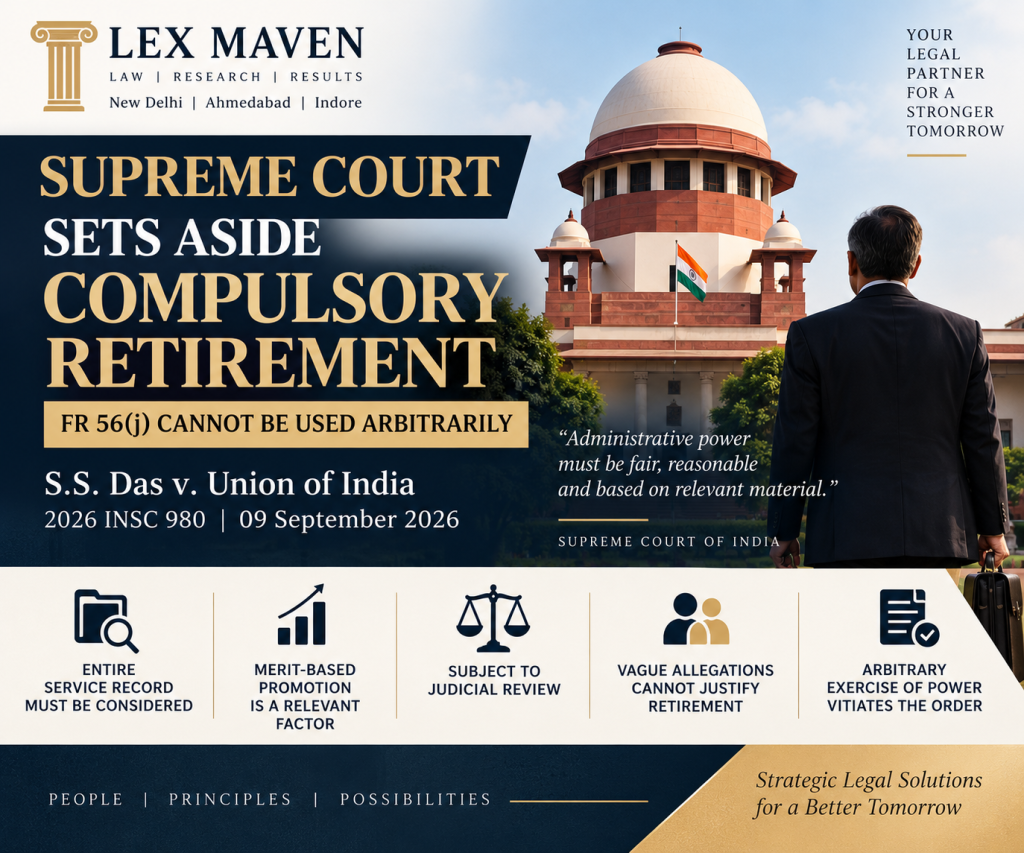
Supreme Court Sets Aside Compulsory Retirement of Senior Government Officer, Holds That FR 56(j) Cannot Be Used Arbitrari
S.S. Das v. Union of India | 2026 INSC 980 | Supreme Court of India | Judgment dated 09 September 2026
The Supreme Court of India has delivered an important ruling on the scope of compulsory retirement under Fundamental Rule 56(j), holding that the power to compulsorily retire a government servant, though administrative and non-punitive in nature, cannot be exercised arbitrarily or on the basis of vague, unsubstantiated and selectively relied upon material.
In S.S. Das v. Union of India, the Court set aside the compulsory retirement of a senior Indian Trade Service officer who had been retired barely a few months after receiving a merit-based promotion to the post of Joint Secretary.
The judgment is particularly significant for service jurisprudence because it clarifies the relationship between an officer’s entire service record, past adverse material, recent performance and a subsequent merit-based promotion while examining an order under FR 56(j).
FR 56(j) Cannot Become a Substitute for Disciplinary Proceedings
The Court reiterated that compulsory retirement cannot be employed as a disguised disciplinary proceeding.
FR 56(j) cannot be used as a shortcut to avoid the safeguards applicable to disciplinary action where the real object is to punish an officer for alleged misconduct.
The power exists to protect public administration from officers who have become inefficient or whose continued retention is genuinely against public interest.
It cannot be converted into a mechanism for removing an officer on the basis of suspicion, conjecture or unsubstantiated allegations.
